Tuesday, October 13, 2015

Review: Progeny Press


We recently had the opportunity to review a digital study guide for Stone Fox from Progeny Press. My 5th grader loves to read, and I thought this would be a neat alternative to the standard book reports that she is used to doing.


What is Progeny Press? This is a company who creates helps for homeschoolers, to allow children to be enriched through their study of great literature. The founders, Michael and Rebecca Gilleland, write all the study guides themselves. The company's mission statement is "To teach our children to think clearly, to understand literature, and to rely on the scripture for truth and values, and enjoy themselves while they do it!" I have to add my own thoughts to this - that when children enjoy what they are studying, they remember it and learn from it so much better! The Progeny Press materials help children to draw out meanings and learn from the books they reading.

What are the Digital Study Guides? Progeny Press has study guides available for all ages - from lower elementary beginning readers all the way through high school level literature. Each guide can be electronically downloaded, and either printed or worked through as an interactive PDF, allowing the student to save their work on the computer as they progress through the guide,

About Stone Fox: This was a book that neither Kelly nor I had ever read before. I was able to borrow it free of charge from our local library. I read it first, and was very drawn in to the story. It is well written, deeply emotional, adventurous, and appealing to young readers. This book tells the story of a brave young boy named Willy and his dog Searchlight. Set in early Wyoming, Willy and his grandfather live alone on a rural farm. When Grandfather becomes ill, Willy is left to be the "man of the house" and save the farm, in a very creative way. Against all odds, he performs the unthinkable. Although he saves the farm, it is not without tragedy.

About the Study Guide: This study guide is recommended for grades 3-6. It is 57 pages long, and is broken down into questions and activities by chapter. There are activities to teach the vocabulary words, comprehension questions, and fun puzzles. There is a map at the beginning to identify the setting, and there are many extra resources at the end, giving websites and ideas to further study any areas of interest from the book. There are also some ideas for projects that parents and students can do together to really make the book and guide into a full unit study.
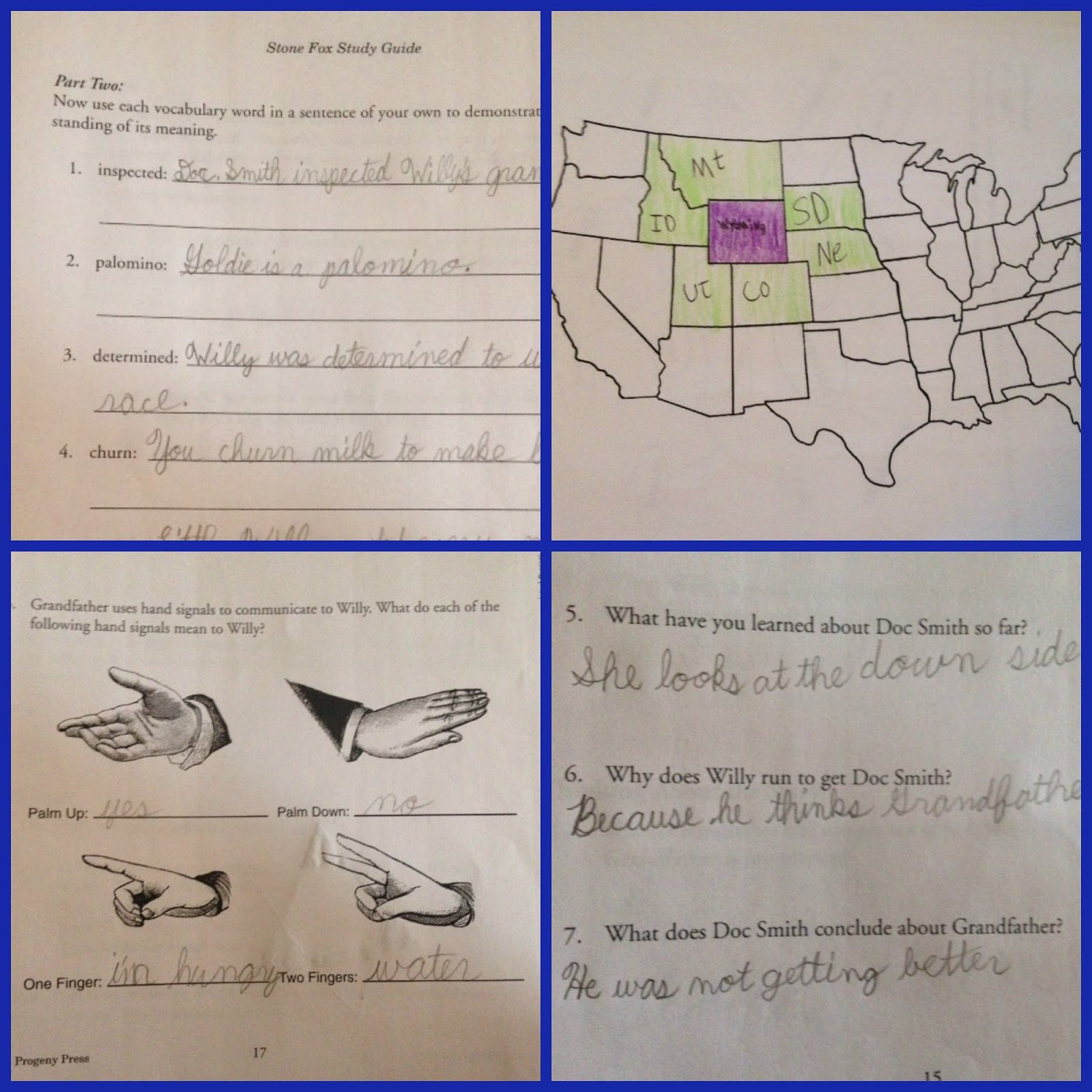

Sample Pages from the study guide.


Printed versus interactive: I chose to print out the entire study guide and place it in  3 ring binder so it could be portable for us to take in the car or work on anywhere. There is also a way to have the student work interactively with the pdf on your computer using Adobe. While they certainly can answer questions by typing, there are some maps or activities that still must be printed to be completed.

The interactive study guide example - Students type in the blue spaces.

A page that would still need to be printed.


How we used this: After obtaining the book from the library, I gave it to Kelly and showed her the study guide. The intention was to read it chapter by chapter, and fill out the study guide as we went. The company suggests doing one page a day so the student enjoys the reading and does not get overwhelmed. Kelly got so engrossed in the book that she ended up reading the entire thing in one sitting. So my intentions did not go as planned, but I certainly was glad she absorbed the story the way she did! She was very emotionally touched by the story. We then went back and Kelly completed the study guide a few pages at a time over the next few weeks.

What we thought: My first thought was that I should have chosen a higher level to challenge Kelly a little more. She is in fifth grade and a very strong reader, and this book and study guide were definitely well below her reading level. I would place this much more at a 3rd grade level, rather than a 3rd-6th grade level. While she enjoyed the story, she was rather bored with the questions and activities in the study guide. She felt that a student who maybe struggled with reading and understanding what was being said might benefit from the help that the study guide would give them to understand the story. She told me she prefers to just read the story then do a book report! (hmmm...good to know!)

I think the study guide was very useful and very thorough in extracting the 'deeper meaning' of the story plot. I also liked the extra vocabulary activities, highlighting unfamiliar words that the student may encounter as they read. The resource section at the end of the study guide had some fascinating and creative ideas for further study. While we only looked at a few of them, I definitely would like to use it to make a complete unit study, possibly over the summer when we would have lots of time to get really creative with it. 

Overall I think Progeny Press does a very good job with their study guides and I would like to try a different book at a more challenging level to be able to have Kelly experience it fully. 

Check out Progeny Press on Social Media:

The TOS Review Crew reviewed a number of titles from Progeny Press. Click the banner below to read some more!

Progeny Press Review

Copyright 2012-2015 - "Be The One" - www.aclassofone.blogspot.com  All rights are reserved. No text, photos, or content may be reproduced without direct permission from the author.

Crew Disclaimer

Thursday, October 8, 2015

The Old Schoolhouse Review Crew


I have been blessed to be a part of the Schoolhouse Review Crew. If you have been around homeschooling for any length of time, you have probably come across an issue of "The Old Schoolhouse" magazine, and like me, enjoyed it greatly. Once I became aware of the great service provided by a large team of real life people who review new products and blog about it, I really became interested in being a part of that. 

Being on the Schoolhouse Review Crew for the last three years has blessed our family and our home school beyond what I could ever describe. We have been exposed to many products that have really enhanced our life - things I would have likely never heard of otherwise. Being a part of the Crew has allowed me to be in on the ground level of testing new products, making suggestions directly to the companies that create them, while giving my children great experiences. Because of the Crew, our family has worked through electives, foreign languages, educational games, books, movies, and curriculum that we would never have been able to experience otherwise. What a tremendous blessing!

I would like to take this moment to share the link to the application for the 2016 Review Year. Applications are now being accepted. If you are a homeschooler with an active blog who likes the challenge of trying new things, and would like to be a blessing as well as receive a blessing, I encourage you to check it out and come join the team! 

For a direct link to the application, click the banner below: 


Schoolhouse Review Crew 2016 Applications

Wednesday, September 30, 2015

Homeschooling High School: Language Arts Resources


In our state, students are required to have four credits of English to graduate high school. Language Arts is a broad term that covers English Grammar, Writing, Composition, Spelling, Vocabulary, Literature, and Critical Thinking Skills. Our goal in our home school is to cover all these areas of Language Arts for four years, which is equivalent to four credits.

Thanks to our core curriculum, A Beka, all of these areas are thoroughly integrated into our daily high school program, so there is not a whole lot extra for me to plan to make up the difference. There are a few programs that I have added to reinforce weak areas that my girls have had, and I will write about them here - how they have helped and enhanced our core curriculum.

Grammar

While I have read much debate in the homeschooling community about whether sentence diagramming is a necessity or not, I would like to advocate that it most certainly is a helpful skill to learn. Being able to pick a sentence apart and correctly identify each part of speech will help the student in so many ways, including comprehension and improvement in their own writing.  Not only that, but learning to properly use punctuation will also make their writing stand out above the crowd, especially as an adult.

Many of the secondary grammar skills, such as identifying various types of clauses and infinitives, are greatly aided when a student learns proper grammar structure. My advice would be to not neglect diagramming and a solid foundation in grammar and punctuation. It should be covered every year starting young, and reviewed every year on a deeper level, until graduation. Most of us never truly 'master' grammar skills, so there is no harm in reviewing them annually for the high school student. Many of their future needed skills in life, including college essays, interviews, scholarship essays, and other job skills will benefit from strong and proper grammar usage.

Writing and Composition

The best way to improve a student's writing is to encourage them to be a reader of fine literature. They will grow accustomed to knowing how sentences are "supposed to sound" and will recognize when their writing is deficient.

While there are many ways to improve writing skills, one of the best ways is to practice, practice, practice! Teach your student to proof read their own work, and re-write when necessary. Edit their papers with a constructively critical eye, and show them how to re-write anything that is less than sound. If you have suggestions for polishing their work, give it. Often students can recognize that their writing 'needs something' but they are not sure exactly how to improve. One thing I have done when correcting and editing is to give two different options for a sentence that needed better structure, then allow the student to choose which one they preferred.

Students should practice writing all types of different papers: research papers, editorials, persuasive essays, dialogues, and journaling are just a few ways to practice various types of writing.

One area that our students found troublesome was writing a biographical sketch. They found it difficult to write about themselves! We used a wonderful program called Fortuigence that assisted in teaching how to layout and construct an essay. We happened to review the "personal statement" program, which was a great help in teaching how to write a biographical sketch without sounding too awkward. The techniques taught in this program are still being used by my now-college student in her essay writing!

Spelling and Vocabulary

Just because they are done with elementary school does not mean high schoolers can let spelling and vocabulary words fall to the wayside! On the contrary, proper spelling makes their writing appear more professional, and good vocabulary words are essential to writing and reading high school level papers and literature! Besides all that, the reading section of the SAT is comprised mostly of questions that demonstrate a strong vocabulary.

There are two programs we have used as resources to assist in spelling and vocabulary. My top go-to program is Vocabulary Spelling City, which can be used for all grade levels, but is especially helpful for review at the high school level. Parents can enter their own lists for the student to practice, or can assign pre-programmed lists. There are SAT vocabulary practice lists already on the program.

For specific SAT type practice, I have found that Wordly Wise is a great program to prepare the student for word analogies, which can be quite challenging. In just a few minutes a day, the student can adequately prepare for the SAT by using either the book or online version.

Literature

Promoting reading and interpreting Literature is one of the most important skills that a high schooler must learn. Readers will continue to educate themselves far past their graduation. If you have a reluctant reader, find material that sparks their interest and run with it. Work with them. Read together and discuss the material. It is vital that high schoolers learn how to read with understanding.

Reading the Bible is imperative not only for Christian growth, but to instill a daily personal walk with God in your high schooler's life, and to guide them in their understanding. If your high school student struggles with their daily devotions and Bible reading, then find a program that will help them read through their Bibles, and perhaps take notes or answer questions about what they read. Read it together as a family, so they can enjoy it and learn from others.

Pearson has published a suggested high school reading list of works that a high school student should be familiar with before graduation. Not all may be appropriate for your family's values, but I have found that reading and discussing literature with your high school student, even things that we might deem inappropriate, allows a great opportunity for the parent to point out the flaws and instill good character in their children. Covering age-appropriate vices in literature helps prepare the student for adult life when they will face these topics on their own without the benefit of parental guidance at their side.

During high school, it is important to have the student read early American literature as well as early English literature. So much of what has been written reflects the culture and aids in understanding history.

Literature also includes Poetry. Some students are naturals at poetry, while others have to really work at it. Any good Literature program in high school will also contain an in-depth look at the various styles of poetry as well as reading and interpreting famous poems. Expose your student to some of the great poems of history, as well as your own personal favorites. You never know when they might take a liking to a certain poet and develop a taste for it. I even have my students memorize poems that I have found useful for character building. I have found that even though the complained a little, they really enjoyed having those poems committed to memory.

These are just a few of my ideas and suggestions for enhancing Language Arts in your home school high school. This is really just scratching the surface of the vast materials that are available. If something is not working, do your diligence and find what does. The Old Schoolhouse Review Crew has a vast number of resources and reviews to help parents find suitable materials, and has a specific Language Arts Pinterest Board with many great ideas for home school parents to use.


Ready for some more ideas? Visit the other blogs on the Homeschooling High School Blog Hop:

Carol from Home Sweet life shares Homeschooling High School- Language Arts (&History!)
Tess from Circling Through This Life shares Teaching High School Language Arts: Resources
Michele from Family, Faith and Fridays shares Language Arts
Wendy from Life at Rossmont shares Highschool Language Arts
Erica from Be the One shares Language Arts Resources
Kym from Homeschool Coffee Break shares History in the Form of Stories
Debbie from Debbie’s Homeschool Corner shares Teaching High School English
Gena from I Choose Joy shares Homeschool High School: Using Socratic Discussion for Literature Studies
Laura from Day by Day in Our World shares How to Teach High School Language Arts Without Tears