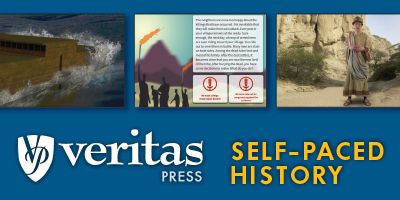
This past six weeks Kelly has had the privilege of reviewing an online History course from
Veritas Press. We were chosen to review the
Self-Paced History: New Testament, Greece, and Rome. We also received the accompanying set of
New Testament, Greece, and Rome Flashcards.
The story behind this program: Veritas Press is a Classical Christian Education Company that was started by a home school family, with the intention of diligently teaching their children in the
Classical Christian methods. From their very first set of History flashcards, they have expanded the available courses into a
full offering of curriculum.
What is the Online Self-Paced Program like? After creating a student account and log in information, Kelly was able to immediately start on her program. The website is pretty easy to navigate, and starts off with a dashboard that lists all 160 lessons, and highlights completed lessons. The student is only able to navigate through the lessons in order, and cannot skip ahead. A lesson is not made available until the prior lesson is completed. Lessons are set up in animated slides, where the student can navigate through each slide, repeat a slide if desired, and pause whenever necessary.
 |
| NT Greek 'tutors' |
What is a typical lesson like? Each program has a 'tutor' - an actor dressed in the clothing of that era who functions as a tour guide throughout the program. A typical lesson lasts about 20 minutes, and includes a variety of interactive materials, including teaching from the 'tutors', map studies, eye-catching graphics, vocabulary training, and review through multiple choice questions and games. Every few lessons there is an interactive worksheet with review questions, and every five lessons there is a test that reviews the most recent segment of lessons.
How do the tests work? Tests are given every five lessons, and students select their answers from multiple choices. Everything is done online, including the tests and worksheets. When the student submits their answers, the test is graded. Students are able to see incorrect answers, but are not able to go back and retake tests for a better grade.
How are grades recorded? Tests and worksheets are averaged together to give the student a course grade. At the end of the course, or end of the school year, parents are able to print out a report card with the student's official grades. Parents are able to go online to their dashboard to view the student's progress and current average.
 |
| Sample of the gradebook - current average is in the upper right corner |
 |
| Example of a flashcard |
Supportive materials: Once a student is logged in to the course, they are able to access a list of suggested literature for extra reading and study. There is even a list that assigns specific pages of the books to coincide with the lessons. Most of the suggested historical fiction books can be found at the library, and we ordered in several for Kelly to read alongside her lessons, which she greatly enjoyed.
What about the flashcards? While we found that the flashcards were not absolutely necessary to complete the online program, they are definitely an asset. The flashcards are large, sturdy, beautifully designed, and colorful. One side has a picture, and the other has nearly a paragraph of information that the student should know for the course. While all 32 of the major historical events pictured on the flashcards are covered in the online lesson, the flashcard makes for a very handy review, especially when tests are looming. The flashcards also contain a handy list of extra resources that the student can look into, including book titles with page numbers that correspond to the information on the card.
What age could use this program? The program is recommended for grades 2-6. Students should be at least seven years old before starting. I think that it would be helpful if students could read somewhat proficiently before using this program as well, since it would make doing the tests and reviews much easier. In our household, Kelly just completed 3rd grade, and reads quite well. She has been able to do this program completely on her own with no extra help. I also wanted to mention that her big sister Melissa, who just finished 7th grade, has sat alongside her and watched the lessons while Kelly was doing them. Even though she is older than the recommended age, Melissa has greatly enjoyed learning from this program as well.
How we used this program: Kelly has enjoyed being able to log on, find her lesson, and do this program on her own. She began with the simple tutorial that showed her how to navigate through the slides. Then she jumped right in to the first lesson. At first, she was completing two lessons daily. I wanted to make sure she was retaining the information, so I slowed down her pace a bit, and limited her to one per day. I must admit that I love a program that motivates my kids to study history so much that I am forced to rein them in! It is neat to hear Kelly asking to do her History lessons, and begging to do a second lesson. Even though we are studying at a very relaxed summer pace, Kelly has looked forward to working on this program since we started. A few times, she has even gone back and repeated previous lessons because she enjoyed them so much. She is very motivated to finish the remaining lessons, even after the review period is over.
What time frame and topics are covered in this course? This course spans the era from 2200 BC to AD 476. It covers the 'world powers' and great civilizations of that era, including the Greeks and the Romans, and the events surrounding the Mediterranean and Middle Eastern lands. It begins with the Minoan and Mycenean cultures, then discusses the Bible lands and the divided kingdoms of Israel and Judah, the Persian and Peloponnesian Wars, the rise of the Romans, the reign of Julius Caesar, the world under Caesar Augustus, the ministry of Jesus Christ, New Testament people and places, the destruction of Jerusalem, Nero, and the split of the Roman Empire. The program ends by studying the fall of the Roman Empire.
Why New Testament, Greece, and Rome? I think it is very important to understand this time period, so that we can better understand our Bibles. Kelly has picked up on several key things that have enhanced her Bible knowledge, including places that the Apostle Paul visited, and the culture of the New Testament people. I was glad for the opportunity to review this period in history, because it is often neglected. While we are careful to study Ancient History, the Middle Ages, and American History, we sometimes have had a gap of knowledge about this important era when our Bible was mainly written, and the setting and culture of the time when Jesus Christ walked this Earth. An understanding of this setting and culture greatly enhances our understanding of our Bible, especially the New Testament. After nearly every lesson, Kelly excitedly talked about what she learned. Understanding how the Greeks worshiped mythological gods was a new concept for her, and it was interesting to see the 'dots being connected' with different things she already knows about her Bible, and Paul's missionary journeys. She commented one day that it was no wonder Paul had to come preach the Gospel to the Greeks!
Other Interesting Tidbits about this program: A cornerstone of this self-paced history program is a catchy song that teaches a chronological listing of 32 important historical events that occurred during this time frame. I have to admit that my very first impression of the song and actors was that they were kind of silly, and I did not think Kelly would tolerate them for long. I was SO wrong! Kelly sings the song regularly, even throughout the day when NOT doing History lessons, and had it easily memorized within the first five lessons. She giggles over the actors and their antics, and is completely taken in by the talking characters, such as an animated mask or Trojan horse. It is amazing to hear her sing a timeline of events, and rattle off facts about ancient cultures.
At any time, students can quickly see an overview of their lesson through the "Table of Contents" and jump back to the page they would like to review:
 |
| Table of Contents |
Each lesson includes "Map Time" where the student drags the labels to their proper places on the map and gets instant feedback about correct answers:
 |
| Map Time |
Interactive worksheets with multiple choice answers help the student to review their facts. All the worksheets are graded and recorded on the student's progress report:
 |
| Review questions |
 |
| Graded reviews |
Animated historical figures made the history lessons come alive:
 |
A talking Trojan Horse
|
Each lesson uses various games for review - "The Labyrinth" was one of Kelly's favorites:
 |
| review games |
My impression: I truly am amazed at how completely and thoroughly Kelly has retained the information taught in this program. I think the integration of various types of reviews, teaching, and quick-moving games and graphics has developed this program into a very successful teaching tool. The lessons and reviews are just long enough to be thorough but not tedious. The repetition of the maps, timeline, and vocabulary words has cemented the facts into her brain. I really cannot say enough good things about this program. We have thoroughly enjoyed using it, and are looking forward to completing it.
If you are looking for a solid History program for your elementary age children, that allows them to work at their own pace and thoroughly learn the facts, with minimal planning, teaching, and record keeping on your part, than your search should stop right here with these Veritas Press Self-Paced History programs.
What does it cost? To register for this course, "Self-Paced History: New Testament, Greece, and Rome", the cost is $199. A sibling can be added to use the same course for $100. The set of flashcards costs $19.95. An entire course includes a full year of 160 daily lessons covering 32 major historical events.
For an online course, what type of computer do I need? Veritas Press has an online
System Compatibility Wizard that you can use to verify whether their programs will work on your system before purchasing.
Veritas Press has a number of online courses available, in both live classes and self-paced classes. I have been perusing their online catalog and wondering about adding some other electives into our curriculum. Using this course has definitely left a very good first impression on me!
Check out Veritas Press online through the following links:
Twitter --
https://twitter.com/veritaspress
Pinterest –
http://www.pinterest.com/source/veritaspress.com/
Google+ --
https://plus.google.com/100404634762414542020/about
The Old Schoolhouse Review Crew has reviewed quite a few different History courses from Veritas Press. If you would like to learn more about them, please click the banner below:
 Copyright 2012-2014 - "Be The One" - www.aclassofone.blogspot.com All rights are reserved. No text, photos, or content may be reproduced without direct permission from the author.