Friday, June 6, 2014

Review: Learning Palette Online Program


I learned of Learning Wrap-Ups many years ago when my oldest was first learning math facts. Over the years, we have gathered quite a collection of wrap-ups, including ones for math, vocabulary, and music theory. I think they are creative and fun, and the kids like being able to turn them over and check their own answers. Recently I was introduced to another fun product produced by the Learning Wrap-Ups Company: the Learning Palette, which is a base with cards and discs to review math and reading facts. We had the opportunity recently to review the LearningPalette.com full online family subscription.

What is the Learning Palette Online Program? It is an online review system designed for K-5th grade, with review questions that correlate to Common Core requirements. The program itself is designed to replicate the actual Learning Palette base, cards, and discs review system, except this is one dimensional on a screen. Students can log in, choose math or reading cards, choose their grade level, then choose a topic within that subject.


Students are taken to a screen that shows the actual circular card with questions and answers in the middle, along with colored discs to slide into the correct answer spaces around the outer edge. Students choose the colored disc based on matching the correct answer with the question. Each card contains twelve questions. Students are timed while they slide the answer discs into place. They can check their answers at any point. When they have all questions answered correctly, a window pops up asking if they are done, and they can then choose whether to continue to the next card or choose a different topic.

The screen looks like this:

Third grade Math

Third grade Reading

How does the program record the student's progress? On the student's page, when a card is completed, the circle next to it turns green, so the student knows that they have already successfully completed it. They can go back and review it again if they wish, though.


The parent can also log on and check on the progress of multiple students with progress reports that record the grade and time it took to complete a particular card. Those pages look like this:


How many children can use this program? Subscriptions are sold for one year's use, and multiple children can use one program. The price is adjusted depending on how many separate student accounts you wish to set up. The program can be used in home schools or classroom situations. 

How much does it cost? For a one year subscription for up to five students, the current cost is $60. For each additional student that is added, there is an additional cost. Discounts are given for multiple students and the entire price list is listed on the website's order form. At the time of this review, the company is offering a 20% discount when ordering, and using the coupon code HOMESCHOOL.


How did we use this program? Kelly is always looking for extra things to do. She is at a good age for lots of fact review, and loves to do "school" games on the computer, so I thought this would be a good fit. Kelly just finished third grade, so I had her selecting mostly third grade cards, to review what we have just finished up this past school year. She would log on 3-4 times a week, with the goal of working on 4 cards each time, (2 in math and 2 in reading) and completing at least 1 card in each subject. We used both the computer, and the iPad to utilize this program. 

What did Kelly think?  Kelly actually didn't like using this program. She had several problems with it. The main problem we encountered was that we found the answer spots, where the colored discs were slid into, to be very sensitive. If the colored disc was not placed exactly right, the program would not register her correct answer. Often we worked on it together, and several times I even ventured onto the program and attempted to complete some cards on my own to see if I had better luck. I did contact the customer service about the problem we were having, and they were extremely attentive and kind. They gave me a different way to log on, and assumed that the problem was a non-compatibility issue with my monitor, although we found that we had the same issues when using the program on the iPad.

The other complaint Kelly had was that the words were very small and hard to read. It was often hard for her to figure out what the correct answer was, because she was having a hard time reading the words. On the iPad she kept expanding it, but then they got blurry and were still hard to read. It was rather frustrating for her. It seems like too much information is packed into a small space on the cards, especially for the age range this is targeted to reach (early elementary readers).

Several times both Kelly and I completed cards but found they were not recorded in the progress reports. The progress reports were also very difficult to read. 

Overall opinion: I really like the concept and visual nature of this product, but I think that the online program really needs some improvements to be more effective. While I think my children might have enjoyed the actual Learning Palette physical product, they definitely were not impressed with the online version and we will not continue using it. 


Crew members reviewed a number of products from Learning Wrap-Ups. Stop by and see what they had to say!

Click to read Crew Reviews
Copyright 2012-2014 - "Be The One" - www.aclassofone.blogspot.com  All rights are reserved. No text, photos, or content may be reproduced without direct permission from the author.


Crew Disclaimer

Tuesday, June 3, 2014

Obscure Bible Heroes {Blogging Through The Alphabet - F}


F is for Fortunatus

Fortunatus is not just a cool name, it is the name of a really refreshing Christian in the book of 1 Corinthians. 

1 Corinthians 16:15  "I beseech you, brethren, (ye know the house of Stephanas, that it is the firstfruits of Achaia, and that they have addicted themselves to the ministry of the saints,)
16  That ye submit yourselves unto such, and to every one that helpeth with us, and laboureth.
17  I am glad of the coming of Stephanas and Fortunatus and Achaicus: for that which was lacking on your part they have supplied.
18 For they have refreshed my spirit and yours: therefore acknowledge ye them that are such."

In this chapter Paul is writing a letter outlining some of his future plans and travels, and giving some final instructions. The book of 1 Corinthians has a lot of doctrine and good amount of correcting as well. In this final chapter, Paul mentions a specific group of people (the household of Stephanas) and holds them up as a good example to follow. Fortunatus is acquainted with this group. I do not know whether he is family or just a friend and co-laborer, but nonetheless, he is listed here. 

There is a mild rebuke to the Corinthian believers, because they did not take care of the physical needs associated with the ministry in the way they should have; but thank God for a man like Fortunatus, who partnered with those who rose to the challenge to meet a need above and beyond what was required of them.

In fact, they had such a good testimony of giving and having a great attitude, that Paul says they were "addicted to the ministry." I am impressed with that statement. What a great thing to be addicted to! Serving others, and living out the Gospel. 

Because of the spirit that Fortunatus had while meeting needs, Paul says that he was "refreshing". He must have been such a helpful, kind, caring man, that gave cheerfully and never sought glory or reward for it. He certainly was "under the radar" in his own eyes. What a blessing that God specifically mentions him by name in the Bible!

How I long to follow this example and be refreshing to those around me. This old world is full of bad news, sadness, sorrow, grief, and negativity. I want my life to counteract all of this by being full of the Holy Spirit, allowing God to love others through me, and meeting the needs of those around me. By doing this, I will be refreshing, like a cool drink on a hot day. 

Like Fortunatus, we too can live for others, and allow God to use us to refresh their spirit and bring them closer to Christ! 

Ben and Me

Copyright 2012-2014 - "Be The One" - www.aclassofone.blogspot.com  All rights are reserved. No text, photos, or content may be reproduced without direct permission from the author.

Thursday, May 29, 2014

Review: Apologia Educational Ministries


Over the past few years we have really enjoyed using Apologia Educational Ministries for their lively and engaging hands-on Science curriculums.

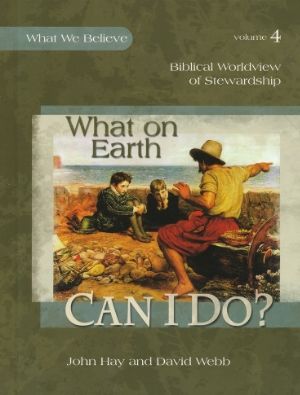
Recently, I was introduced to the "What We Believe" series that Apologia offers, which is a complete four year cycle curriculum that assists parents in teaching Apologetics and a Biblical World View to their children. We had the privilege to review book four of this series, called "What on Earth Can I Do?" over these past seven weeks. Along with the beautiful hardcover 294 page book, we also received the "What on Earth Can I Do?" Notebooking Journal for Melissa to use, the "What on Earth Can I Do?" Junior Notebooking Journal for Kelly to use, and the "What on Earth Can I Do?" coloring book that both girls really enjoyed. Although this is the fourth book in the series, it can stand alone, and does not require that the user has completed the first three books in order to use this one.

Why teach a Biblical World View to children? It is very important, in fact, I believe an absolutely fundamental practice of parenting, to teach and instill a Biblical World View to your child. The responsibility of the parent, especially a Christian parent, is to equip their child with the means necessary to make good decisions for the rest of their lives. Today's culture is so self-centered that most people grow up thinking life is all about them, and they are at the center of their own universe. Many people make decisions solely based on how the outcome will affect their own life. This is not Biblical, and leads to failure on many fronts.  A Biblical world view will afford a person to have God in the center of their decision making, applying Biblical and Godly principles to their decision making. No longer is the decision about pleasing self, but rather it becomes all about pleasing God. When our relationship with God is right, our relationships with others will drastically improve and be satisfying as well.

To me, this course is all about learning our standing with God, so that we can learn how to take care of the gifts He has entrusted us with. 

What is the main theme of this book? "What on Earth Can I Do?" teaches a Biblical worldview of stewardship. The chapters discuss and teach such topics as how God is planning of our life's story, faithfulness, character, and managing our relationships, treasures, time, and talents. The stories are written in a simple (but profound) manner that a child can understand.

What is the purpose of the notebooking journals?  The Notebooking and Junior Notebooking Journals are meant for the student to use to write their own notes and stories about what they have learned from the lessons.  There are also some review pages, with questions and a word puzzle, to reinforce the new vocabulary words and terms learned in each lesson. Each lesson also contains a minibook for the student to make as well as relevant coloring pages and a Bible verse for copywork.  While both books have basically the same information, the junior notebooking journal is definitely simpler and geared for younger ages.

How are the lessons organized? The book contains eight lessons. The plan that is included calls for a student to work on one lesson over the course of three weeks, approximately two days a week. This would allow the entire book and accompanying journals to be completed in about 24 weeks. Of course, parents can adjust this workload to meet their own needs.

What does a typical lesson include?  Each lesson starts off with "The Big Idea" which introduces the concept of that lesson and sets the foundation for further exploration of the topic. Other key components are "What Will You Do?" that states learning objectives for the student, a "Short Story" to see how the lesson can relate to real life, using real people, historical events, and biographical sketches. There is also a "Hide It In Your Heart" page that gives relevant Bible verses, and a "Words You Need To Know" page that explains new vocabulary words that are learned in that lesson. There is an opportunity for prayer and for the student to set their own goals in the "What Should I Do?" section. Also woven throughout the lesson are various historical or scientific stories, as well as biographies of some famous people. Overall, the lessons are very diverse, weaving many different aspects of life (parables, art, history, science, music, inventions, literature) into the worldview lessons being taught, making them relevant and very relatable, and not some distant concept that cannot be grasped.

What ages can use this? The curriculum itself is recommended for grades 1-6. We used it with a 3rd and 7th grader. I don't think I personally would have used this curriculum with a student younger than 3rd grade though. I could see slightly older children still enjoying and learning from it, especially if it is being used in a family setting.

Real Life Topics discussed: The book started off in the first chapter with several stories from the WWII era, including Nazi Germany. This actually went along well with what we were studying in history at that time, so it was very complimentary. There are many historical features to the stories in the book. The beginning section of the book seems to rely heavily on WWII stories, while the latter section of the book uses many stories from the African plains.

How Did We Use This?  We have been progressing through the lessons, using the books about 3 days a week. We sit together, and I read the stories while the girls listen, color, or take notes in their journals. They complete the copywork, word puzzles, and minibooks on their own. I have found that they do better on the question and personal notes pages when we do them together following discussion. This seems to help them formulate the thoughts of what they would like to write down and remember about the lesson.

Coloring Pages
How about the results? The girls have really seemed to enjoy the time we have invested into this curriculum. They have thrived on our "worldview" discussions, which makes me a very happy mom. I enjoy watching them learn ideas, then see how it can apply to their life. Extracting the concepts from the history lessons really made them come alive to the girls. No longer were these just stories, but the people became much more real, and the girls seemed to be able to empathize much more with the situations that the characters were living through. We enjoyed the 'parables' which added fictional names and details to familiar Biblical parables. I saw the girls' eyes light up with an "I never thought of it that way before" type of look.

Personal Recommendation: I really think this curriculum is meant for a parent to use as a springboard for discussion and teaching a Biblical world view to their children. Personally, I would not just hand these books over for my children to read and work through on their own. I think the most benefit can be found by actually doing them together, giving the parent a golden opportunity to mold the child's thinking on various matters. Most of the learning we experienced took place during our discussion time. I viewed the lessons merely as a creative platform to get the discussion started, which I greatly enjoyed because these were concepts I have desired to discuss, but this book dropped the opportunity right in my lap, in a way that was enjoyable, profitable, and not boring to the girls.

What the girls thought: Both girls have enjoyed using these books. They have also enjoyed flipping through the books and re-reading some of the stories. I have tried to make it enjoyable for them by doing some extras, like actually watching a Charlie Chaplin film after reading about him, or weaving threads together to make a tapestry such as was discussed in lesson one. I think their favorite thing though, was coloring while listening to me read the stories. The coloring book is lovely and very well done.

What the girls learned: I would like to share (in their own words) some of the notes that the girls wrote in their journals:
  • God is the Master Weaver and He is making a tapestry that will tell a story about you. He uses even the trials to make a greater and better story about you. 
  • If you know God and you are His child, you get special privileges that people who are lost do not have. You can go right to God and ask for His help and guidance.
Personal Preference: Naturally, the book uses a lot of Scriptures. There are several different translations used. The girls found this very confusing. Since we only use KJV in our home, we looked up all the verses in our own Bibles anyways. I think it would be better for the book to just list the Scripture references, and allow the reader to look it up and read it on their own, rather than switch between various translations and have all the Scriptures printed out.


  • "What On Earth Can I Do?" hardcover book: $39.
  • Junior Notebooking Journal: $24
  • Notebooking Journal: $24
  • Coloring Book: $8
All of the books have sample pages on the Apologia website. I would highly recommend taking a look at them if you are seriously considering this series. And let me say that the coloring book really does compliment the curriculum nicely, and I think it is well worth spending the extra to get it, if your children like that kind of thing. 

Find Apologia on Social Media:

Many Crew members had the opportunity to review this wonderful series in their homes. Click the banner below to read how they used it:

Click to read Crew Reviews
Copyright 2012-2014 - "Be The One" - www.aclassofone.blogspot.com  All rights are reserved. No text, photos, or content may be reproduced without direct permission from the author.


Crew Disclaimer